60kW DC Fast Charger Cost: Unit Price, Installation and Running Cost
A 60 kW DC fast charger is not priced by equipment alone. For a commercial project, separate the charger unit price, freight and import costs, civil works, electrical distribution or grid upgrades, commissioning and ongoing electricity charges. An indicative 60 kW charger equipment price can be USD 8,000–16,000 ex works from a Chinese EVSE factory, but the delivered and installed project cost depends on the selected configuration and site conditions.
Buyers searching for a 60 kW DC charger price often compare numbers that cover different scopes. A factory quotation normally covers the charger cabinet in a specified configuration. It does not automatically include shipping, duties, local electrical work, transformers, switchgear, permits, civil construction or commissioning. For a usable budget, request those items separately and compare like with like.
What does a 60 kW DC fast charger cost per unit?
As an equipment reference, a 60 kW DC fast charger may be quoted at USD 8,000–16,000 per unit ex works. This is an indicative factory range, not a universal installed price. The final equipment quotation changes with connector mix, charging guns, cable length, payment and access-control hardware, communication hardware, certificates, branding, order quantity and the destination market.
| Cost layer | What it normally includes | What to confirm before comparing quotes |
|---|---|---|
| Charger equipment | DC charger cabinet, selected power rating, connectors and standard control hardware | Power, number of guns, CCS1/CCS2/GB/T/CHAdeMO configuration, OCPP, RFID, display and cable requirements |
| Delivered equipment | Charger equipment plus freight, insurance, import charges and local transport | Incoterm, destination port or address, duties, taxes and unloading responsibility |
| Installed station | Delivered equipment plus electrical works, civil works, installation, testing and commissioning | Available grid capacity, transformer/switchgear work, trenching, permits and local labor scope |
Why installation and grid work can cost more than expected
Installation cost is site-specific. A charger placed beside an existing, adequately sized electrical supply is a different project from a site requiring a new transformer, medium-voltage connection, long cable runs, trenching, concrete works, utility applications or local permits. A 60 kW charger also needs a three-phase supply and sufficient upstream capacity; the required design must be confirmed by the local electrical contractor and utility where applicable.
Ask each bidder to show the boundary between equipment supply and site delivery. This avoids treating a factory price as a turnkey project price. For fleet depots and public charging sites, the project budget should also allow for commissioning, network setup, payment integration where required, signage and ongoing maintenance arrangements.
60 kW DC charger per unit charging cost: how to calculate it
The per unit charging cost is not the same as the charger purchase price. At minimum, it starts with the electricity tariff for the energy purchased from the grid. For example, if electricity costs USD 0.15 per kWh, delivering 40 kWh of energy has an electricity input cost of about USD 6.00 before demand charges, payment fees, maintenance, network fees, site rent and margin.
For a commercial station, use this planning formula:
Charging cost per kWh = electricity tariff + demand-charge allocation + payment and network fees + operating and maintenance allocation + site-cost allocation + target margin.
| Cost item | How it affects the cost per kWh |
|---|---|
| Energy tariff | The base price paid for each kWh purchased from the grid. |
| Demand charges | Can materially change economics where the utility bills for peak site demand. |
| Charging losses | The energy purchased and the energy billed to the driver may differ; use the metering method agreed for the project. |
| Payment and platform fees | Card processing, payment service, roaming and charging-management fees may apply. |
| Operations and maintenance | Include inspection, repair, connectivity, software and spare-parts planning. |
| Site costs and margin | Rent, land, staff, financing and the required project return are commercial inputs, not charger specifications. |
Do not use one electricity-price example as a universal public charging tariff. The correct selling price depends on the local tariff structure, utilization, peak-demand profile, local tax treatment and the operator’s commercial model.
How charger power changes the budget
Higher power can improve vehicle turnaround, but it can also increase the electrical infrastructure required at the site. Select charger power from expected dwell time, vehicle battery capability, daily traffic, available grid capacity and the number of charging points needed. A charger that is oversized for site demand may raise capital and demand-charge exposure without improving utilization.
- 20–60 kW: often considered for smaller commercial sites, workplaces, destination charging and fleets with longer dwell times.
- 60–240 kW: suits commercial charging, public parking and fleet projects that need higher throughput or a dual-gun arrangement.
- 240 kW and above: requires a project-level review of utility capacity, power distribution and anticipated utilization.
What to include in a DC fast charging station quote request
A comparable quotation starts with a clear project brief. Provide the installation country, required power, quantity, connector standard, available input voltage, approximate cable route, desired charging-management platform, access method and target delivery destination. If the project uses public payment, fleet authorization or third-party management software, include that requirement before equipment selection.
- Installation country and delivery destination
- Required charger power and quantity
- CCS1, CCS2, GB/T, CHAdeMO or mixed connector requirement
- Available three-phase supply and known site grid capacity
- OCPP backend, RFID, APP or payment-integration requirements
- Whether the quote is equipment-only, delivered equipment or installed project scope
FAQ
Is the 60 kW charger price the full installation price?
No. A factory equipment price is different from delivered and installed project cost. Freight, import charges, civil works, electrical work, permits, grid upgrades and commissioning may be separate.
What is the running cost of a 60 kW DC charger?
The running cost depends on the electricity tariff and the station’s demand charges, operating costs, network and payment fees, utilization and business margin. The 60 kW rating describes maximum charger power; it does not define the cost per kWh.
Does a higher-power charger always deliver a better return?
Not necessarily. Higher power can reduce charging time for compatible vehicles, but project economics depend on actual traffic, dwell time, grid cost and utilization. Select the power rating for the site rather than assuming the largest rating is the best fit.
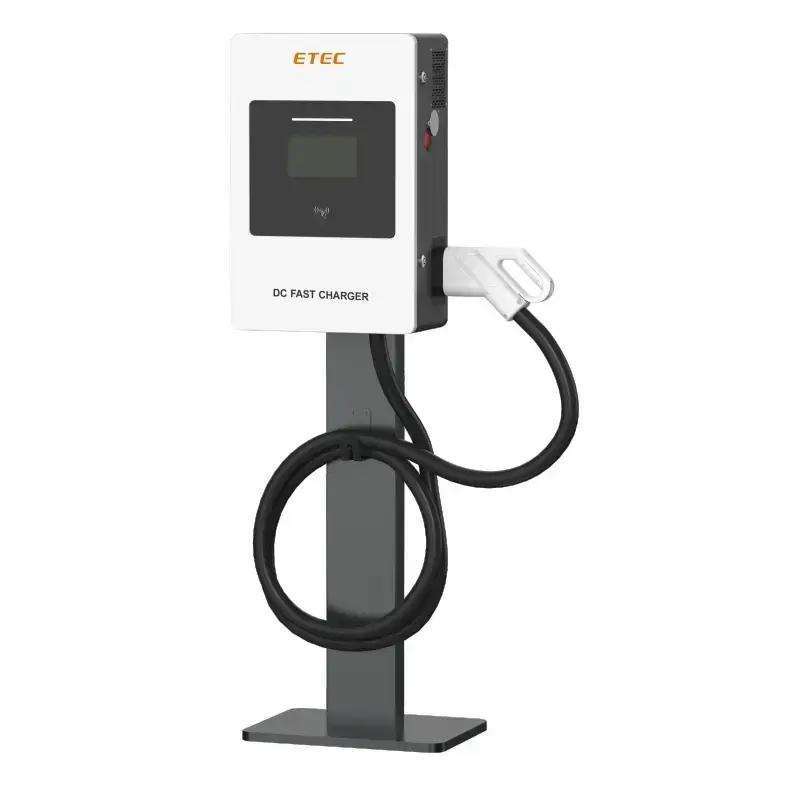
For a product overview, see ETEK’s DC fast EV charging station range. For 20–60 kW projects, review the EKDC1 compact DC charger; for 60–240 kW commercial projects, review the EKDC2 DC fast charger.
To request a project quotation, share the site location, target power, quantity, connector standard and available electrical capacity. ETEK can then recommend a suitable DC fast charging configuration and supply scope.