Types of Circuit Breakers: MCB, MCCB, ACB, RCCB, RCBO and AFDD Compared
Types of Circuit Breakers: MCB, MCCB, ACB, RCCB, RCBO and AFDD Compared
The main types of circuit breakers used in low-voltage systems are MCBs, MCCBs and ACBs for overcurrent protection, plus RCBOs that combine overcurrent and residual-current protection. RCCBs detect residual current but do not provide overload or short-circuit protection by themselves. AFDDs detect hazardous arc-fault signatures, while isolators provide deliberate disconnection rather than automatic fault protection.
Understanding these different types of circuit breakers starts with the fault each device is designed to address—not its appearance, current marking or everyday name. The right family also depends on voltage, AC or DC duty, fault level, breaking capacity, poles, protection characteristics, coordination, environment and applicable standards. This guide maps the families and their typical applications without providing installation or wiring instructions.
Quick Answer: What Are the Main Types of Circuit Breakers?
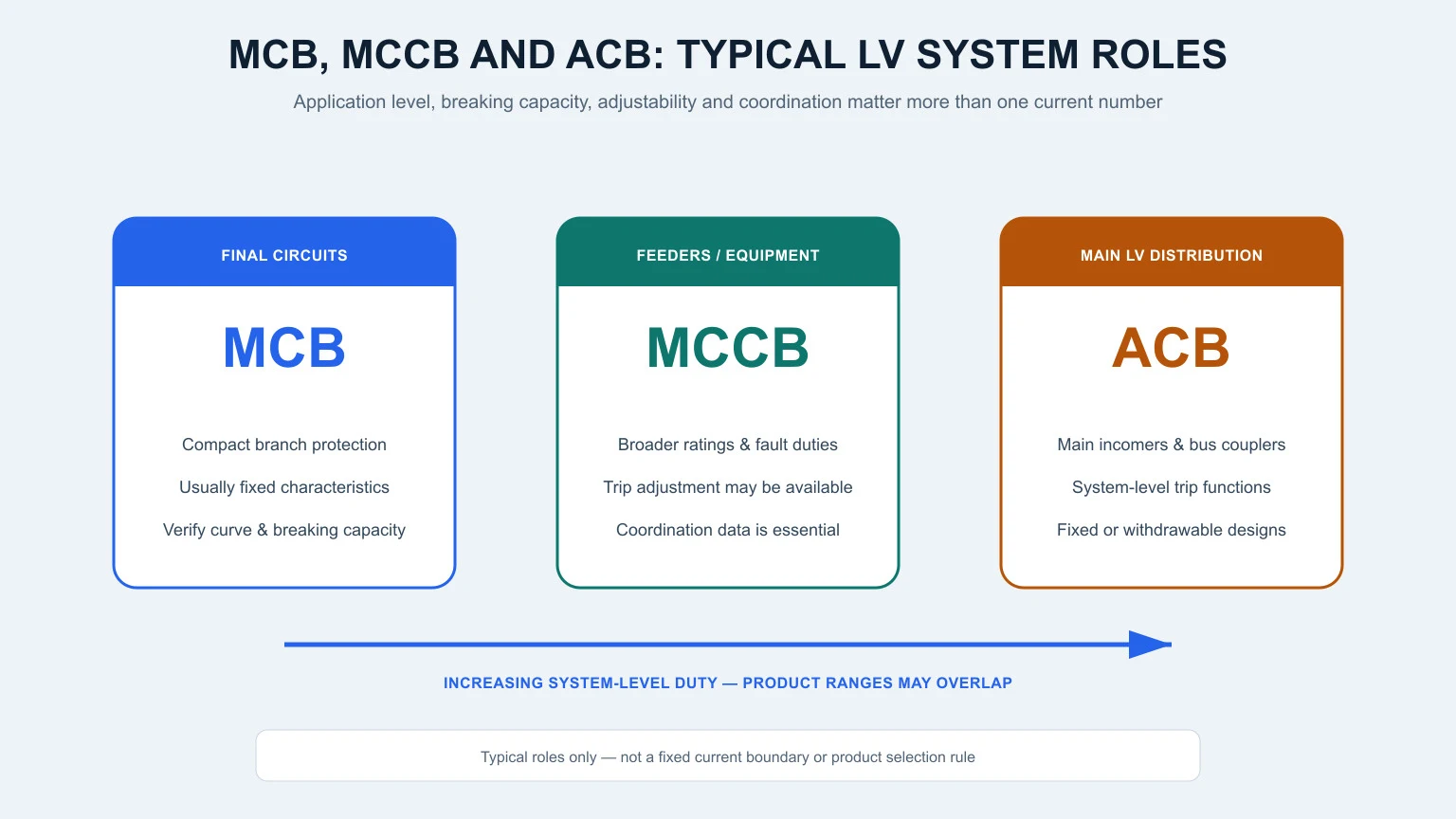
MCBs generally protect lower-current final circuits and small distribution circuits; MCCBs serve feeders and larger commercial or industrial loads with broader rating and trip-unit options; and low-voltage ACBs commonly protect main incomers, bus couplers and high-current distribution. All three are overcurrent breaker families, but their capabilities overlap and no universal current boundary separates them. An RCBO combines overload, short-circuit and residual-current protection. An RCCB/RCD responds to earth-leakage imbalance and needs coordinated overcurrent protection. An AFDD looks for dangerous arc signatures, but its other included protections vary by product. An isolator is a switching and isolation device, not an automatic protective breaker.
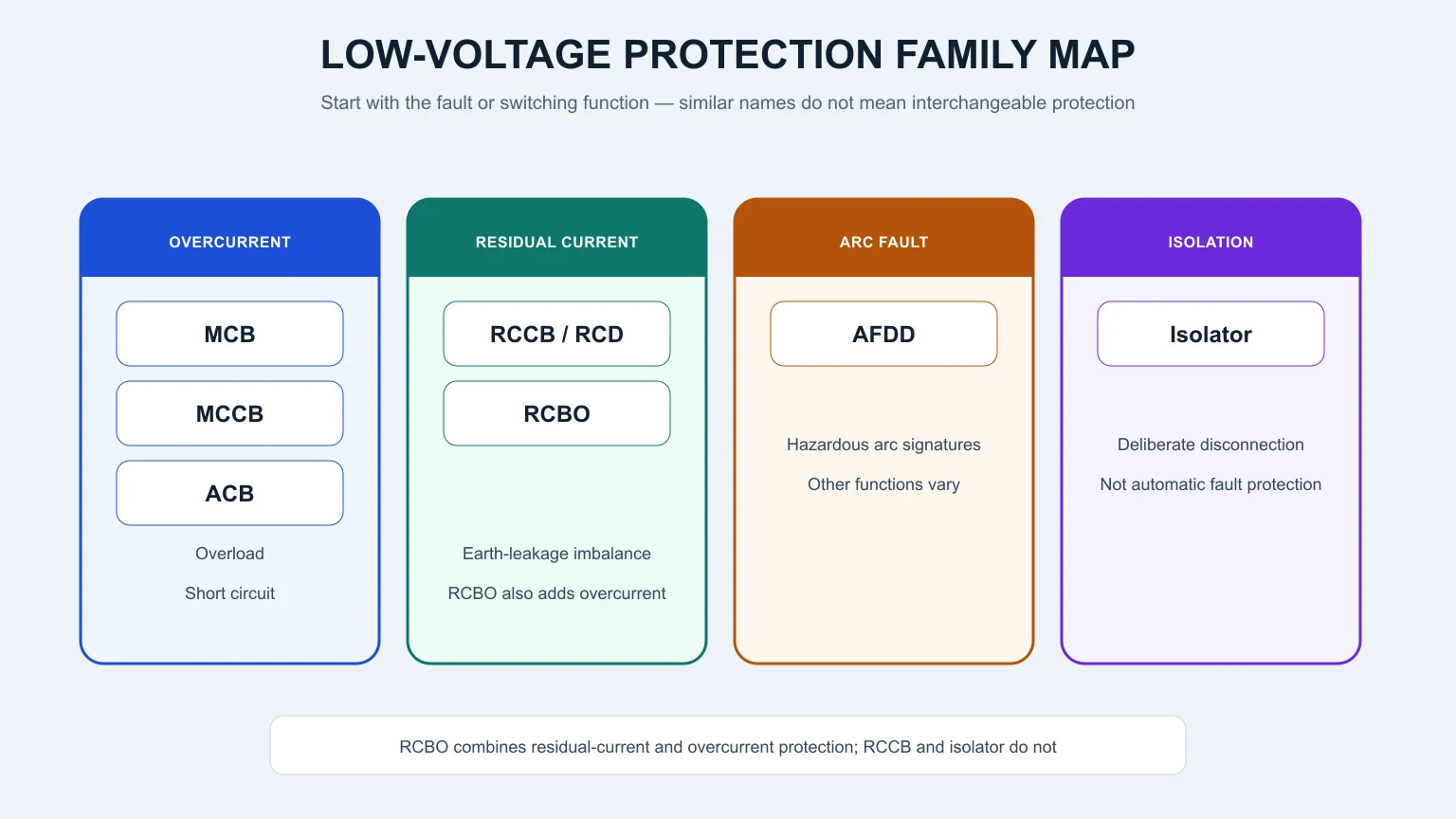
Circuit Breaker Types Comparison Table
| Device | Main fault or role | Overload protection? | Short-circuit protection? | Residual or arc protection? | Typical application level | Key selection distinction |
|---|---|---|---|---|---|---|
| MCB | Overcurrent | Yes | Yes | No, unless another function is integrated | Final circuits and lower-current distribution | Compact, usually fixed thermal-magnetic characteristics; verify curve, rating and breaking capacity |
| MCCB | Overcurrent | Yes | Yes | Optional functions depend on model and accessories | Commercial and industrial feeders or equipment | Broader ratings and breaking capacities; adjustable or electronic trips may be available |
| ACB | Overcurrent and distribution-system protection | Yes, according to trip unit | Yes, according to trip unit | Additional protection depends on trip unit/system | LV main incomers, bus couplers and high-current boards | System-level coordination, trip-unit functions and fixed/withdrawable construction |
| RCBO | Overcurrent plus residual current | Yes | Yes | Residual-current: yes; arc: not inherently | Individual final circuits | Combines MCB-like and RCD functions; verify residual-current type and ratings |
| RCCB/RCD (related protective device) | Residual-current imbalance | No | No | Residual-current: yes | Groups of circuits or defined loads | Requires coordinated overcurrent protection; never substitute it for an MCB or MCCB |
| AFDD | Hazardous arc-fault signatures | Depends on product | Depends on product | Arc: yes; residual-current depends on product | Selected final circuits where required or justified | Determine whether it is standalone or integrates MCB/RCBO functions |
| Isolator/switch-disconnector (related device) | Manual switching and isolation | No | No | No | Local or system isolation | Not automatic fault protection; ratings and switching duty still matter |
“Yes” in the table describes the family’s normal protective scope, not proof that any device suits a particular system. Exact ratings, trip functions, standards and limitations come from the selected product’s current documentation.
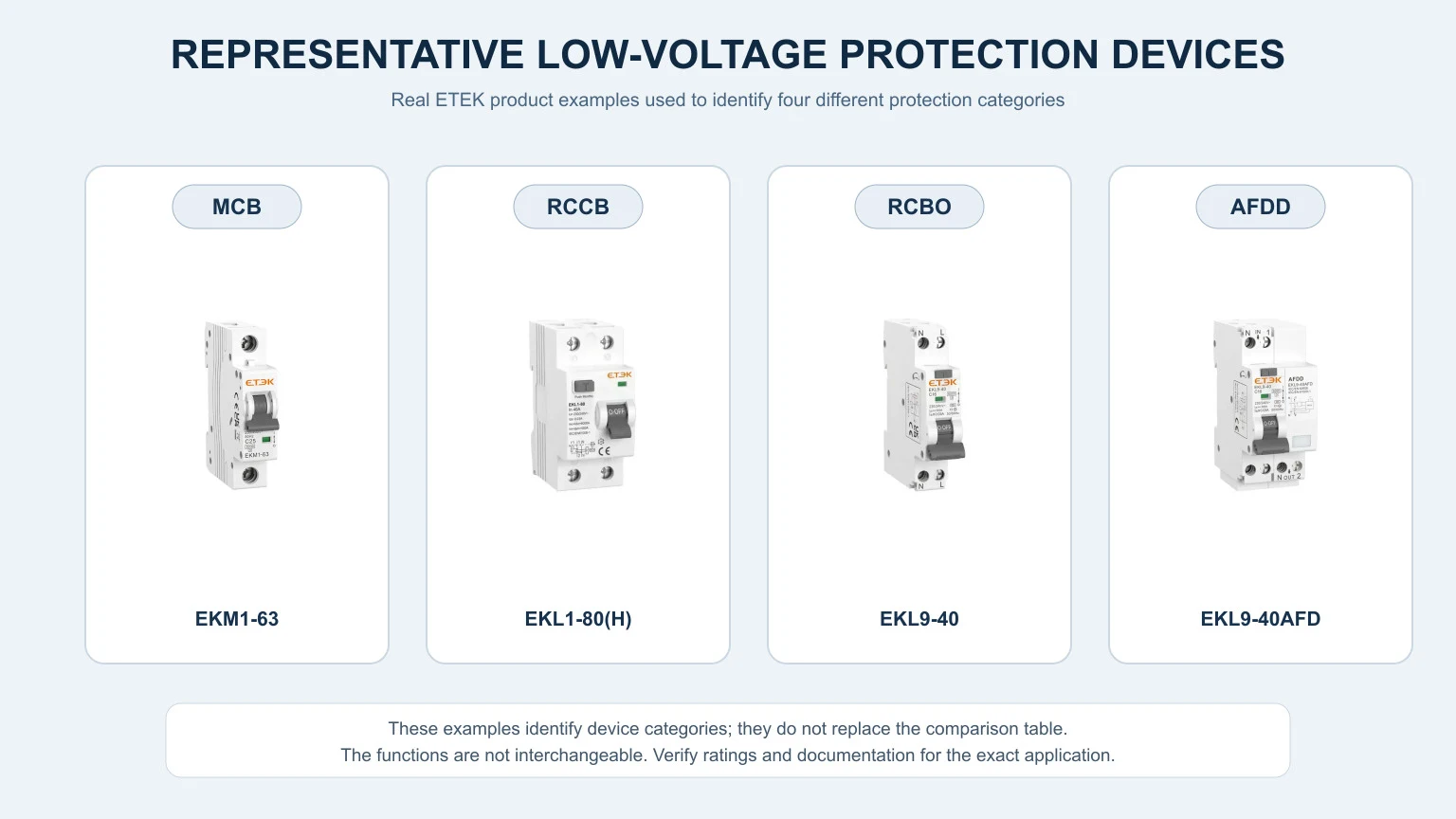
1. MCB: Miniature Circuit Breaker
An MCB is a compact overcurrent protective device commonly used for final circuits and lower-current distribution. It opens automatically for overloads and short circuits within its declared characteristics. Many MCBs use thermal-magnetic operation: the overload response is time-dependent, while high fault current produces a faster magnetic response. Detailed operation is covered in this guide to how an MCB works.
MCBs commonly have fixed characteristics rather than the adjustable trip units found on many larger breakers. B, C and D designations describe instantaneous trip ranges under the applicable product framework; they are not general labels for “better” protection. Selection requires load and inrush assessment, conductor protection, rated voltage, number of poles, breaking capacity, fault level, ambient conditions and AC/DC suitability. The MCB amp rating applications guide explores why rated current alone is insufficient.
IEC 60898-1 is a common reference for household and similar installations, while some industrial circuit breakers fall under IEC 60947-2. Always verify the exact standard and marked ratings. A device designed and tested for AC must not be assumed suitable for DC.
2. MCCB: Moulded Case Circuit Breaker
An MCCB is an enclosed overcurrent circuit breaker generally chosen where feeder current, fault level, adjustability or industrial duty exceeds the practical scope of an MCB. MCCBs are common in commercial and industrial distribution, machinery supplies, sub-main feeders and generator or transformer-related LV systems. They typically cover broader current and breaking-capacity ranges, but “MCB below X amps, MCCB above X amps” is not a reliable universal rule; product ranges overlap.
Depending on the model, an MCCB may use thermal-magnetic or electronic protection and may offer adjustable long-time, short-time, instantaneous or ground-fault functions. These capabilities are not universal. Frame size, rated current, interrupting capability, utilisation category, trip settings, accessories and coordination data must all be read from the exact documentation.
MCCB selection is a protection-engineering task, especially when selective operation with upstream and downstream devices is required. IEC 60947-2 is a central reference for many industrial circuit breakers, but compliance, editions and regional approvals must be checked for the product and market. This article does not imply the availability of any particular manufacturer’s MCCB.
3. ACB: Air Circuit Breaker
A low-voltage ACB is a high-current circuit breaker that interrupts the arc in air and is commonly used at main distribution level. Typical roles include transformer secondary incomers, generator incomers, bus couplers and outgoing ways in major LV switchboards. The device may be fixed or withdrawable, and its electronic protection unit may support sophisticated measurement, communication and coordination functions; exact features vary.
Compared with an MCCB, an ACB is often selected where switchboard architecture, maintainability, high continuous current and system-level selectivity favor it. That is a typical distinction, not an absolute current threshold. Engineers must evaluate short-circuit withstand, making and breaking capacities, trip-unit functions, service conditions, interlocking strategy and the complete assembly.
A low-voltage ACB should not be confused with the historical term “air-blast circuit breaker” used in some high-voltage contexts. Both involve air, but they describe different equipment classes and operating technologies. This article discusses LV ACBs as part of a low-voltage distribution family map and does not represent that any specific ACB product is offered.
4. RCBO: Residual Current Breaker with Overcurrent Protection
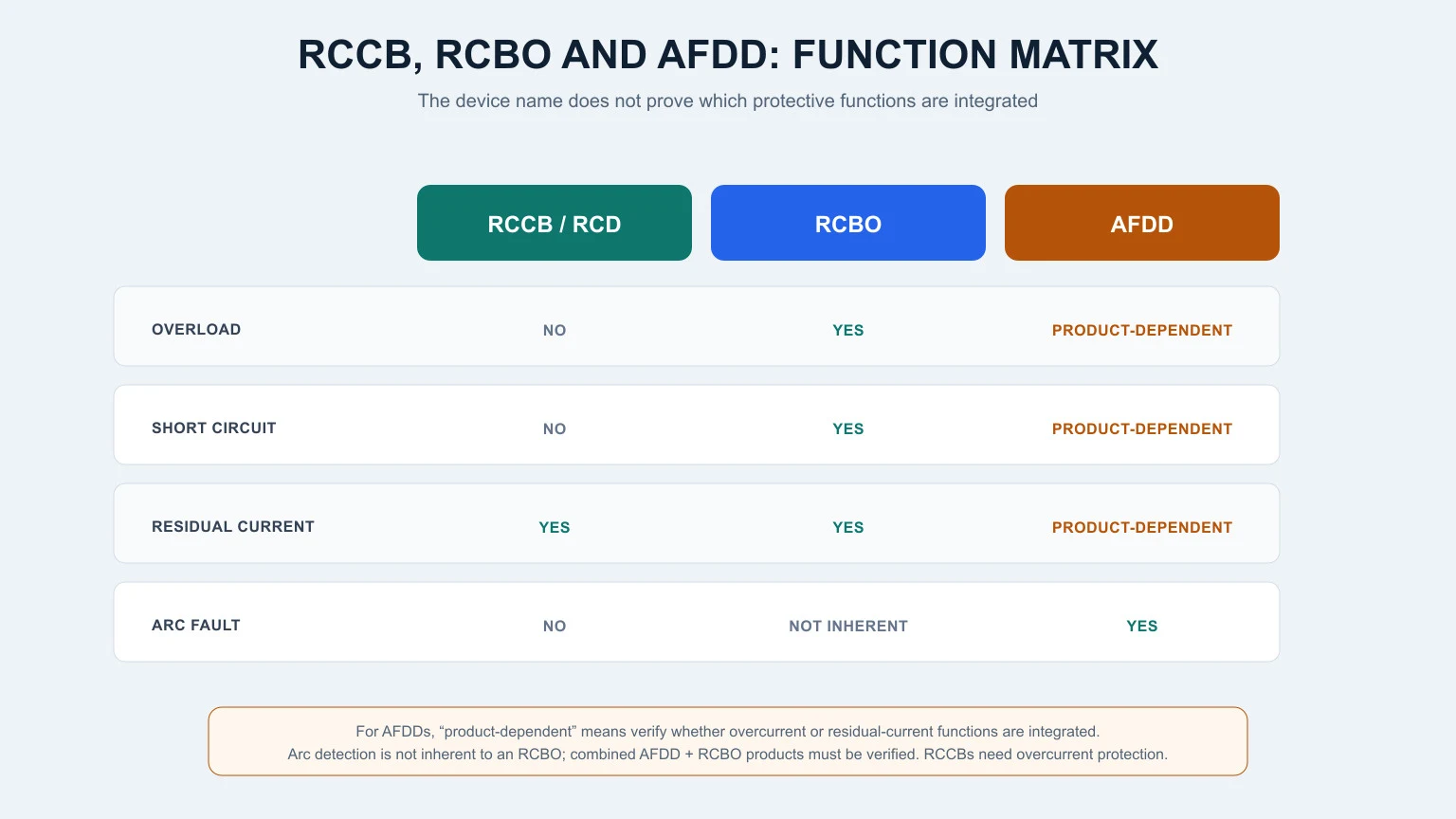
An RCBO combines residual-current detection with overload and short-circuit protection in one device. It is commonly used on individual final circuits where both conductor overcurrent protection and additional residual-current protection are required. Individual RCBOs can also improve fault localisation: a residual-current event on one protected circuit need not automatically remove every circuit served by a shared upstream RCCB, subject to the complete design.
Selection must cover both sides of its function. Overcurrent checks include rated current, trip characteristic, voltage and breaking capacity. Residual-current checks include rated residual operating current, RCD type, frequency content and suitability for the connected equipment. Type AC, A, F and B classifications respond to different residual-current waveforms; the required type depends on loads, regulations and product scope, not a simple preference.
IEC 61009-1 is commonly relevant to RCBOs for household and similar uses. Review available RCBO protection devices only after defining the system requirements and target-market standards.
5. RCCB/RCD: Residual-Current Protection Without Overcurrent Protection
An RCCB detects an imbalance between live conductors that indicates current is flowing through an unintended path. By disconnecting under specified residual-current conditions, it can reduce shock and fire risks. “RCD” is the broader residual-current-device term; an RCCB is a residual-current-operated circuit breaker without integral overcurrent protection.
An RCCB does not protect against overload or line-to-line/line-to-neutral short-circuit current by itself. It must have properly coordinated overcurrent protection. It must never be selected as a substitute for an MCB or MCCB simply because “circuit breaker” appears in its name. The dedicated MCB vs RCD comparison explains this boundary in more depth.
Key choices include rated current, rated residual operating current, RCD type, poles, conditional short-circuit requirements and coordination with overcurrent devices. See RCCB residual-current protection options only after those requirements are defined. IEC 61008-1 is commonly relevant to RCCBs for household and similar uses. Residual-current protection supports—not replaces—sound earthing, bonding, overcurrent protection and required protective measures.
6. AFDD: Arc-Fault Detection
An AFDD analyses electrical signatures to identify hazardous arcing conditions that conventional overload, short-circuit or residual-current devices may not detect reliably. Such signatures may arise from damaged conductors, degraded connections or insulation defects. The device uses signal-processing criteria intended to distinguish dangerous arcs from normal arcing created by switches, motors or connected electronics.
AFDD implementation varies significantly. One product may provide arc detection only and require separate overcurrent and residual-current protection; another may integrate MCB functions, and another may combine arc, overcurrent and residual-current functions. Therefore, “AFDD” alone does not establish that an MCB or RCBO can be omitted. Check the complete declared functions, poles, ratings and coordination requirements.
IEC 62606 is a common reference for arc-fault detection devices. Whether AFDD protection is required or recommended depends on local rules, occupancy, construction, circuit use and risk assessment. See the AFDD arc-fault protection range for documented function comparisons.
Commonly Confused Device: Isolator or Switch-Disconnector
An isolator or switch-disconnector provides deliberate switching and a defined isolation function; it does not automatically trip for overload, short circuit, residual current or arc faults. Its purpose is to establish a safe disconnected state when operated under the conditions for which it is rated. Some switches can make or break specified load current, while an isolation-only function may have different operating limitations.
IEC 60947-3 covers switches, disconnectors and switch-disconnectors within its scope. Required utilisation category, voltage, current, poles and AC/DC duty still need verification. In photovoltaic systems, for example, a DC-rated protective breaker and a DC isolator switch answer separate questions: one concerns automatic fault interruption and the other deliberate isolation. Their presence in one assembly does not make their functions interchangeable.
Low-, Medium- and High-Voltage Circuit Breaker Families
The MCB, MCCB and ACB comparison is primarily a low-voltage classification. At medium and high voltages, breakers are also classified by insulation and interruption technology. Vacuum circuit breakers (VCBs) are widely associated with medium-voltage systems; SF6 equipment has been used across MV/HV applications; and oil circuit breakers are an older technology still encountered in some installations. Alternative gas and vacuum technologies continue to evolve.
These technologies are not substitutes for DIN-rail devices. Their system voltages, insulation coordination, operating mechanisms, arc-control methods, maintenance regimes and switchgear standards differ fundamentally. Selection at those levels requires specialised power-system engineering and consideration of current environmental and regulatory requirements, particularly for insulating gases.
How to Choose the Right Circuit Breaker Type
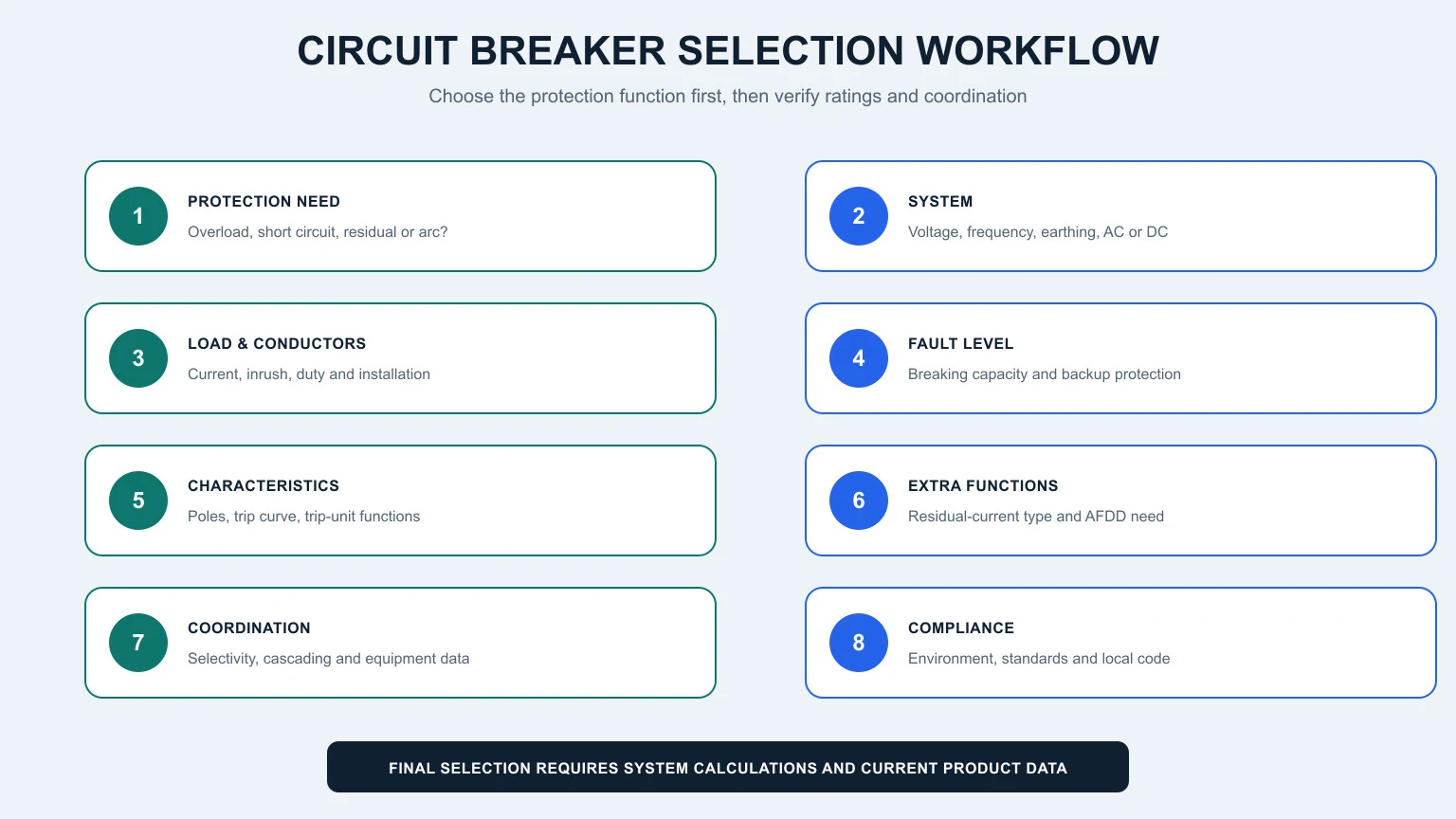
- Define the required protection. Identify overload, short-circuit, residual-current and arc-fault risks separately. Also define whether deliberate isolation is needed.
- Confirm the electrical system. Record nominal and maximum voltage, frequency, earthing arrangement, AC or DC operation and any source-specific behavior. Never transfer an AC rating to DC without explicit documentation.
- Assess load and conductors. Determine design current, starting or inrush current, duty cycle and conductor current-carrying constraints under actual installation conditions.
- Establish prospective fault current. The breaker’s applicable breaking capacity must meet the fault level at its installation point, with any backup arrangement fully documented.
- Select poles and protection characteristics. Match pole arrangement, trip curve or trip-unit functions, neutral treatment and switching requirements to the system design.
- Check residual and arc requirements. Where relevant, choose residual-current sensitivity and waveform type, and determine whether AFDD functions are required. Confirm which functions are integrated.
- Verify coordination. Evaluate discrimination/selectivity, cascading or backup protection, energy limitation and coordination with upstream, downstream and connected equipment using manufacturer data.
- Confirm environment and compliance. Consider ambient temperature, altitude, enclosure effects, pollution, vibration, ingress protection, current standards, approvals and local code.
A qualified electrical professional should complete the calculations, selection, coordination and verification against the actual system and current local requirements. A checklist cannot turn a product label into a compliant design.
Application Examples
Residential final circuit
A lighting or socket final circuit may use an MCB where the protection architecture provides residual-current protection elsewhere. An RCBO may instead provide overcurrent and residual-current protection for that individual circuit. The decision depends on local rules, load behavior, conductor design, fault level and the desired fault localisation—not merely the appliance wattage.
Commercial or industrial feeder
An MCCB is often considered for a feeder where higher breaking capacity, broader ratings or adjustable protection supports coordination with branch devices. A fixed-trip MCCB may suit one design while an electronic trip unit is needed in another. Actual fault calculations and manufacturer selectivity data govern the choice.
Main low-voltage distribution
An ACB may serve a large board’s main incomer or bus coupler when high-current capability, withdrawable construction, maintainability and advanced trip-unit coordination are appropriate. An MCCB may serve the main role in a smaller system. Neither family should be chosen from current alone.
EV charging
An EV charging circuit typically needs coordinated overcurrent protection, residual-current protection suited to possible DC leakage, and surge protection where required. Some charging equipment incorporates DC residual-current detection; others rely on external provisions. Device type must follow charger documentation, system design and applicable charging-installation requirements.
Solar PV DC circuit
A photovoltaic DC circuit may require a DC-rated breaker for overcurrent or fault interruption and a separate DC isolator for deliberate disconnection. DC voltage, polarity, available fault current, number of poles and the PV source’s behavior are critical. An AC breaker is not acceptable merely because its current rating looks suitable.
Frequently Asked Questions
1. What are the most common types of circuit breakers?
In low-voltage systems, MCBs are common on final circuits, MCCBs on larger feeders and equipment supplies, and ACBs at major distribution level. RCBOs add residual-current protection to overcurrent protection. RCCBs and AFDDs address residual-current and arc-fault risks respectively, but their included functions must be distinguished.
2. What is the difference between MCB, MCCB and ACB?
All three interrupt overcurrent. MCBs are compact devices commonly used on final circuits with mostly fixed characteristics. MCCBs generally offer broader ratings, breaking capacities and possible adjustment. LV ACBs commonly serve high-current main distribution with system-level trip and switchboard functions. Their ranges overlap, so no universal current cutoff applies.
3. Is an RCCB a circuit breaker for overloads?
No. An RCCB trips for specified residual-current imbalance, not ordinary overload or short-circuit current. It needs properly coordinated overcurrent protection, such as an MCB or another suitable protective device, according to the system design.
4. Does an RCBO replace an MCB and an RCCB?
An RCBO integrates overload, short-circuit and residual-current protection and can perform those functions for the circuit within its ratings. It does not eliminate the need to verify upstream protection, breaking capacity, discrimination, RCD type, isolation requirements and all local rules.
5. Is an AFDD the same as an RCBO?
No. An AFDD detects characteristic arc-fault signatures; an RCBO provides overcurrent and residual-current protection. A combined product may include both sets of functions, but a standalone AFDD does not automatically replace an RCBO. Read the exact functional declaration.
6. What is the difference between a circuit breaker and an isolator?
A circuit breaker automatically interrupts specified faults and may also be capable of switching and isolation when declared. An isolator provides deliberate disconnection but no automatic fault detection. Never assume an isolator supplies overload or short-circuit protection.
7. Can an AC circuit breaker be used for DC?
Only if the manufacturer explicitly rates the exact device and pole configuration for the required DC voltage and duty. DC arcs are harder to extinguish because current has no natural cyclic zero. The AC MCB vs DC MCB guide explains the selection boundary.
8. Which circuit breaker is used for industrial applications?
Industrial systems may use MCBs for auxiliary or final circuits, MCCBs for feeders and machinery supplies, and ACBs for major LV distribution. RCBOs, RCCBs and AFDDs may address additional risks. The correct family follows system voltage, current, fault level, load, coordination and standards rather than the word “industrial.”
Final Selection Principle
To compare types of circuit breakers, match the protection function first, then verify every electrical and coordination rating. MCB, MCCB and ACB identify overcurrent-breaker families; RCBO identifies combined residual-current and overcurrent protection; RCCB does not include overcurrent protection; AFDD function and integration must be checked; and an isolator is not automatic fault protection.
After the system requirements are defined, buyers can compare ETEK MCB, RCBO, RCCB and AFDD options against current product documentation. Product comparison does not replace fault calculations, coordination studies, local requirements or final selection by a qualified electrical professional.