What Is OCPP in EV Charging? A Buyer’s Guide to the Protocol
OCPP, or the Open Charge Point Protocol, is the standardized communication language between an EV charger and a charging station management system (CSMS). The charger uses it to report what is happening on site, and the operator’s software uses it to send approved commands back. For commercial charging buyers, OCPP matters because it can reduce dependence on one hardware or software vendor, provided that the selected charger and CSMS support the same version and functions. If the two sides do not match, the connection will not work as expected.
The protocol is maintained by the Open Charge Alliance (OCA). It does not replace the electrical or vehicle-side standards used at the connector. OCPP sits between the charging station and the back-office platform, whereas ISO 15118 concerns communication between the vehicle and charger.
What does the OCPP protocol do?
A connected charger generates operating information continuously. OCPP provides a common way to exchange that information with a CSMS, rather than relying on a proprietary interface. Depending on the version, product configuration and CSMS implementation, it can support, for example:
- Charger availability and fault status, such as Available, Charging, Faulted or Unavailable.
- User authorisation through RFID, apps, local lists or other configured methods.
- Session start and stop records, including time, connector and transaction status.
- Meter values for energy, power and other measurements that the station reports.
- Remote operational commands, including remote start/stop, resets and selected configuration changes.
- Firmware and diagnostics workflows.
- Smart-charging profiles that help an operator manage site demand or allocate available power.
This is why an OCPP EV charger is usually easier to bring into a multi-site operating model. The operator can view stations from a central system, set policies across a fleet and change management platforms without necessarily replacing functioning hardware. That outcome still depends on a tested integration, not on the protocol label alone. In other words, the label is a starting point, not a guarantee.
How an OCPP charging session works
The message flow is straightforward from an operator’s perspective, although the exact sequence depends on the configured access method:
- Connect and identify. The charger establishes its configured connection to the CSMS and reports that it is ready. A driver plugs in and presents an RFID card, starts a session in an app or uses another approved access method.
- Authorise and start. The CSMS or the charger checks whether the user is allowed to charge. Once approved, the station starts the transaction and records the relevant session context.
- Report during charging. The charger sends status updates and meter values at the configured intervals. The CSMS can display the session, raise an operational alert or apply a smart-charging limit where the deployed system supports it.
- Stop and close. When the driver ends the session, the vehicle stops charging or an authorised remote command is issued, the charger closes the transaction and sends final values.
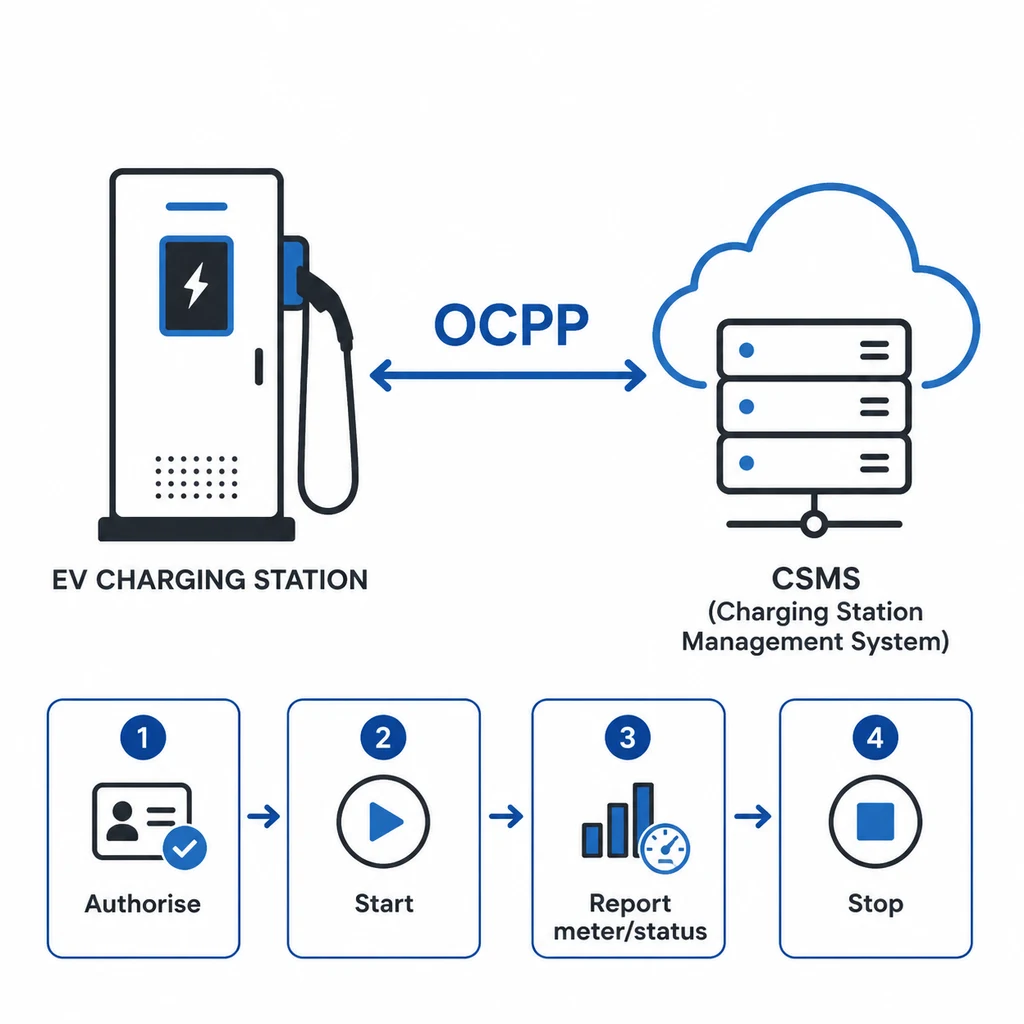
It is not a payment system, a roaming protocol or a wiring diagram. A project may use other services for payments, driver access and roaming. The important buying question is whether the charger-to-CSMS link has the required version, features and security configuration for the intended operating model. In short, OCPP covers one link in the chain, not the whole chain.
OCPP versions: 1.6, 2.0.1 and 2.1
The three OCPP versions currently supported by OCA differ in maturity and scope. However, a later version is not automatically the right choice for every deployment: installed CSMS capability, site requirements and verified interoperability matter more than version numbers alone.
| Version | Release and protocol position | Buyer-relevant capabilities | Compatibility note |
|---|---|---|---|
| OCPP 1.6 | Released in 2015; widely deployed. It supports SOAP and JSON over WebSocket. OCPP 1.6J means the JSON-over-WebSocket profile of OCPP 1.6. | Core charging operations, transaction records, status, diagnostics and smart charging. | Confirm whether both ends use the same 1.6 profile and optional features. |
| OCPP 2.0.1 | Released in 2020. OCPP 2.0.1 Edition 3 was approved as IEC 63584 in 2024. | Stronger security framework, device management, improved transaction handling, smart charging, display/messaging functions and ISO 15118 support. | Not backward compatible with OCPP 1.6. A 1.6 charger and a 2.0.1-only CSMS need a supported migration or integration path. |
| OCPP 2.1 | Released in 2025 and maintained by OCA. | Adds ISO 15118-20 support, bidirectional charging/V2X, distributed energy resource (DER) control, battery swapping and additional transaction and payment options. | Builds on OCPP 2.0.1; OCA states that 2.0.1 application logic remains compatible with 2.1. Check actual product and CSMS support. |
For a procurement specification, write the protocol version and the required functional profiles separately. “OCPP 2.x” is not a complete requirement. For example, a buyer may need remote diagnostics, a particular smart-charging workflow, certificate handling or ISO 15118 support. Those items must then be verified on the charger firmware and CSMS release proposed for the project. Otherwise, the specification can be met on paper but fail in operation.
Why commercial buyers care about OCPP
More control over the operating stack
A commercial site may operate for 8 to 15 years while software providers, ownership structures and fleet requirements change. An open charger-to-CSMS interface can give the owner more options when choosing or changing a management platform. It is not a guarantee of a frictionless migration, but it gives the project a standard basis for assessing alternatives. In short, the protocol keeps the door open without promising that every change will be easy.
Better visibility across sites
For EPCs, fleet operators and charging-network owners, remote visibility is an operational requirement. The protocol can supply the status and session data needed for a CSMS to monitor availability, investigate faults and coordinate field service. That can reduce unnecessary visits when the information and remote functions are actually configured and tested. As a result, field teams can often resolve issues without a site call.
A clearer way to specify future requirements
Smart charging, device management and higher security expectations are increasingly part of commercial tenders and funding rules. The protocol gives project teams shared language for defining the charger-to-platform interface. It does not by itself prove compliance with a local programme, so the full tender and jurisdictional requirements must still be checked. Nevertheless, specifying OCPP in a tender is a useful first step.
Less dependence on closed interfaces
A proprietary cloud connection may be sufficient for a small, single-brand deployment. The risk grows when a site has multiple charger types, several locations or a requirement to retain operational choice. The protocol gives buyers a practical criterion to discuss data access, remote control, migration and service obligations before a purchase order is issued. In that sense, it is a procurement tool as much as a technical one.
What to check when buying an OCPP charger
Use this checklist in a tender, technical clarification or factory acceptance plan.
1. Compatibility, not just a protocol label
Ask for the exact charger version, transport/profile and firmware release. Then confirm that the chosen CSMS supports the same version and required functions. If the project needs OCPP 1.6J, state that explicitly; if it needs 2.0.1, define the relevant profiles and migration path from any existing 1.6 estate. In either case, put the requirement in writing.
2. Certification evidence
OCA operates certification programmes for OCPP implementations. Ask the supplier to provide the applicable certificate or a current listing that identifies the product, software or product family and tested version. Certification is useful evidence of conformance, but it does not replace end-to-end testing with the selected CSMS. Similarly, do not infer an OCA certificate from a generic “OCPP compliant” statement.
3. Tested functions for the actual site
Prepare a short acceptance script: connect the charger, authorise a driver, start and stop a session, receive meter values, trigger the required remote command, test an alert and verify any smart-charging control. Add firmware updates, diagnostics, reservation or local authorisation only where the project needs them. Finally, record the charger firmware, CSMS version and test result.
4. Credentials, ownership and handover
Clarify who owns the CSMS account, charger identifiers, certificates, credentials and configuration backup. The handover package should state how the operator can change endpoints, rotate credentials, revoke access and recover the station after a communications outage. In practice, these details often determine whether an OCPP connection is operationally useful after commissioning. If they are left unclear, the connection may work technically but remain hard to operate.
Security: specify the deployment, not a slogan
OCPP 2.x includes a more mature security framework, with features that cover secure connection setup, security events and secure firmware-update practices. As a result, it is a stronger base where the project, charger and CSMS all support the relevant requirements.
OCPP 1.6 should not be treated as inherently unsafe, nor should it be assumed secure by default. For example, it can be hardened through TLS-protected communications, controlled VPN or private-network access, certificate and credential management, restricted remote administration and timely firmware maintenance. The deployed charger firmware and CSMS must support the selected controls. In addition, security should be documented in the site design and verified at commissioning.
Frequently asked questions
Is OCPP free?
OCPP is an open protocol; there is no inherent per-charger protocol royalty. However, charger firmware, CSMS subscriptions, integration work, security operations, testing and certification can all involve cost. In practice, the protocol itself is free to use, but the surrounding services are not.
Does a home charger need OCPP?
Not always. A simple private home charger may work well with a local app or a vendor service. The protocol becomes more valuable when the owner wants central management, multi-brand hardware, access control, energy management or the option to change platforms later. For most home users, however, a vendor app is enough.
Can any OCPP charger connect to any CSMS?
No. Both systems need a compatible version, transport/profile and set of functions. Optional features, charger firmware, configuration, security settings and vendor-specific implementation quality can all affect the result. Therefore, require a documented interoperability test before rollout.
OCPP 1.6 vs 2.0.1: what is the difference?
OCPP 1.6 remains common and widely supported, especially as 1.6J. In contrast, OCPP 2.0.1 adds a device model, improved transaction handling, stronger security capabilities, enhanced smart charging and ISO 15118 support. It is not backward compatible with OCPP 1.6, so an upgrade needs a deliberate compatibility plan.
What does OCPP stand for?
OCPP stands for Open Charge Point Protocol. It is the communication protocol between a charging station and a charging station management system.
OCPP options in the ETEK DC charging range
For projects that need OCPP 1.6J connectivity, ETEK’s DC Fast EV Charging Station category is the starting point for comparing commercial DC configurations. The EKDC2 is a 60-240 kW dual-gun DC fast charger with OCPP 1.6J listed on its product page. For higher throughput, the EKDC3 covers 60-480 kW sites, while the EKDC6 is a 240-600 kW split system with OCPP 1.6J for its network connection. Where controller-led charger development is the goal, the EKEPC3-C/S OCPP EV Charging Station Controller is the relevant product.
Beyond protocol compatibility, ETEK’s published Level 3 EV charger guide covers hardware selection. Confirm the current product page, datasheet, firmware and CSMS test scope before specifying any charger for a live site.