Level 3 EV Charger Guide: How to Choose DC Fast Charging (20–600 kW)
Level 3 EV Charger Guide: How to Choose DC Fast Charging (20–600 kW)
A level 3 EV charger is a commercial DC charging system that feeds direct current to the vehicle battery, so the car’s onboard AC charger is not the bottleneck. For site owners, EPCs, distributors, and charge point operators, buy in this order: power band first, then connectors, then gun count and power sharing, then OCPP/backend, then whether the site can actually feed and host the hardware. For a broader walkthrough, see the ETEK EV charging station buying guide.
Highest kW is not automatically best. A 60 kW unit can be right for a dealership, destination lot, or low-turnover fleet. Highway or high-turnover public sites often land in the 240–480 kW band. Split systems toward 600 kW belong where several bays, a central power cabinet, and high utilization justify the extra site work.
Key Takeaways
- In commercial procurement, Level 3 EV charging and DC fast charging usually mean the same equipment class.
- Pick the power band from dwell time, session demand, and available electrical capacity—not from a brochure maximum alone.
- Connectors must match the vehicles and markets you serve (for example CCS1 vs CCS2).
- Two guns do not guarantee full rated power on two vehicles at once; read the sharing rules.
- OCPP only helps if version, platform, and link method are specified—not just “supported.”
- Transformer, switchgear, cabling, civil works, and network access can kill a project before the charger is ordered.
Is a Level 3 EV Charger the Same as DC Fast Charging?
For commercial buyers, treat a Level 3 EV charger and a DC fast charger as one product family. Both put DC into the battery at rates far above ordinary AC charging.
The label changes by market. “Level 3” shows up often in North American search and sales talk. “DC fast charging” is common in datasheets, catalogs, and cross-border projects. Either way, you are specifying a commercial DC station—not a home wallbox.
The family is wide. A 20 kW DC unit and a 600 kW split hub are both “DC fast,” but they solve different jobs. Spec from how the site runs, not from the category name alone.
Typical commercial uses:
- Public sites where drivers need a short, high-power top-up
- Fleet depots with planned return windows
- Dealership and service lanes for delivery, demo, and workshop charge
- Retail and hospitality lots where faster charge improves bay turnover
- Highway and logistics corridors where throughput is the product
Choose Power Before Choosing a Charger Model
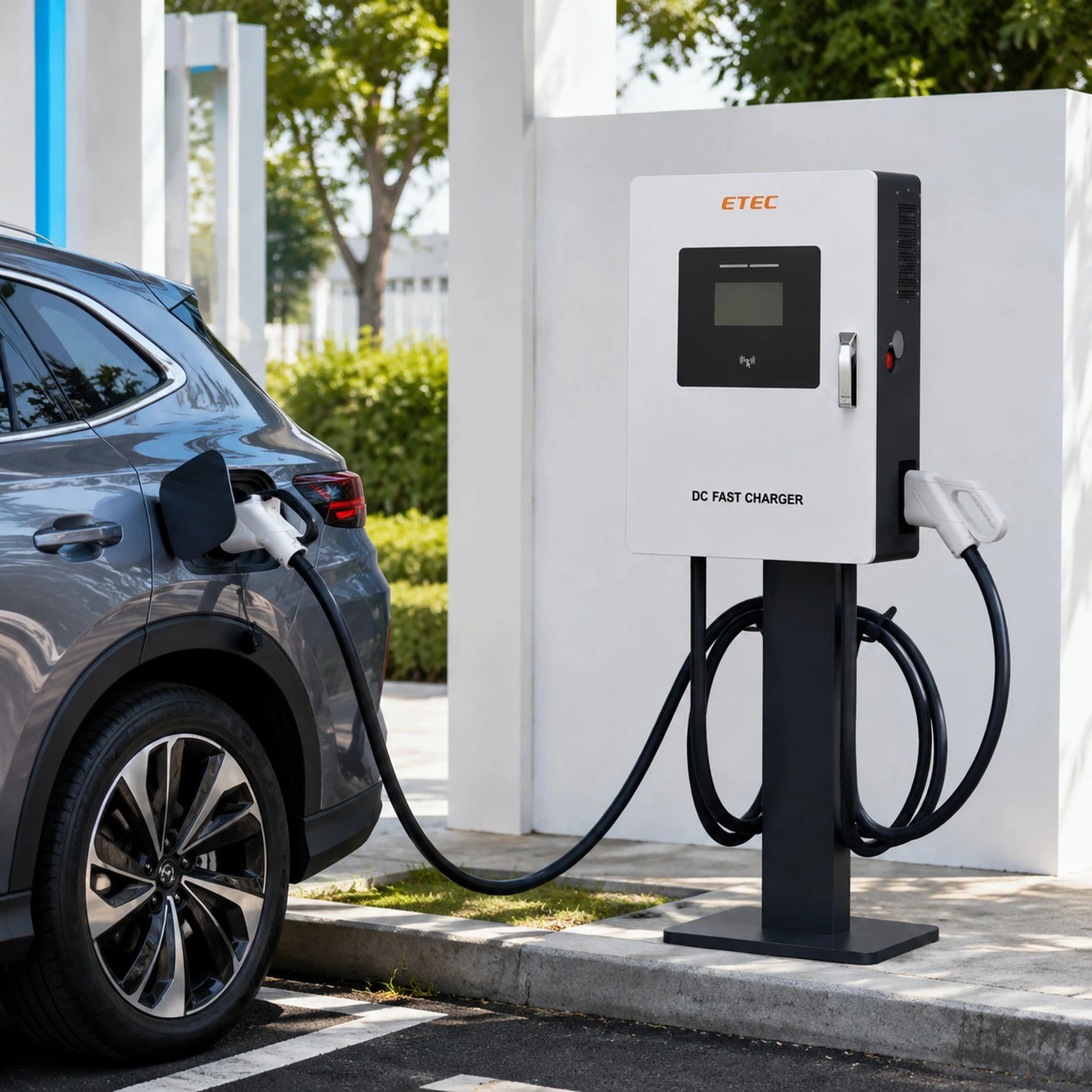
Nameplate power sets the station’s role. It drives throughput, upstream electrical design, footprint, budget, and which vehicles can use the output well.
A high rating does not mean every EV will pull that power. The car’s DC limit, battery temperature, state of charge, BMS, and the station’s allocation rules all cap the session. Size for the throughput you need on site, not for the largest number on a price list.
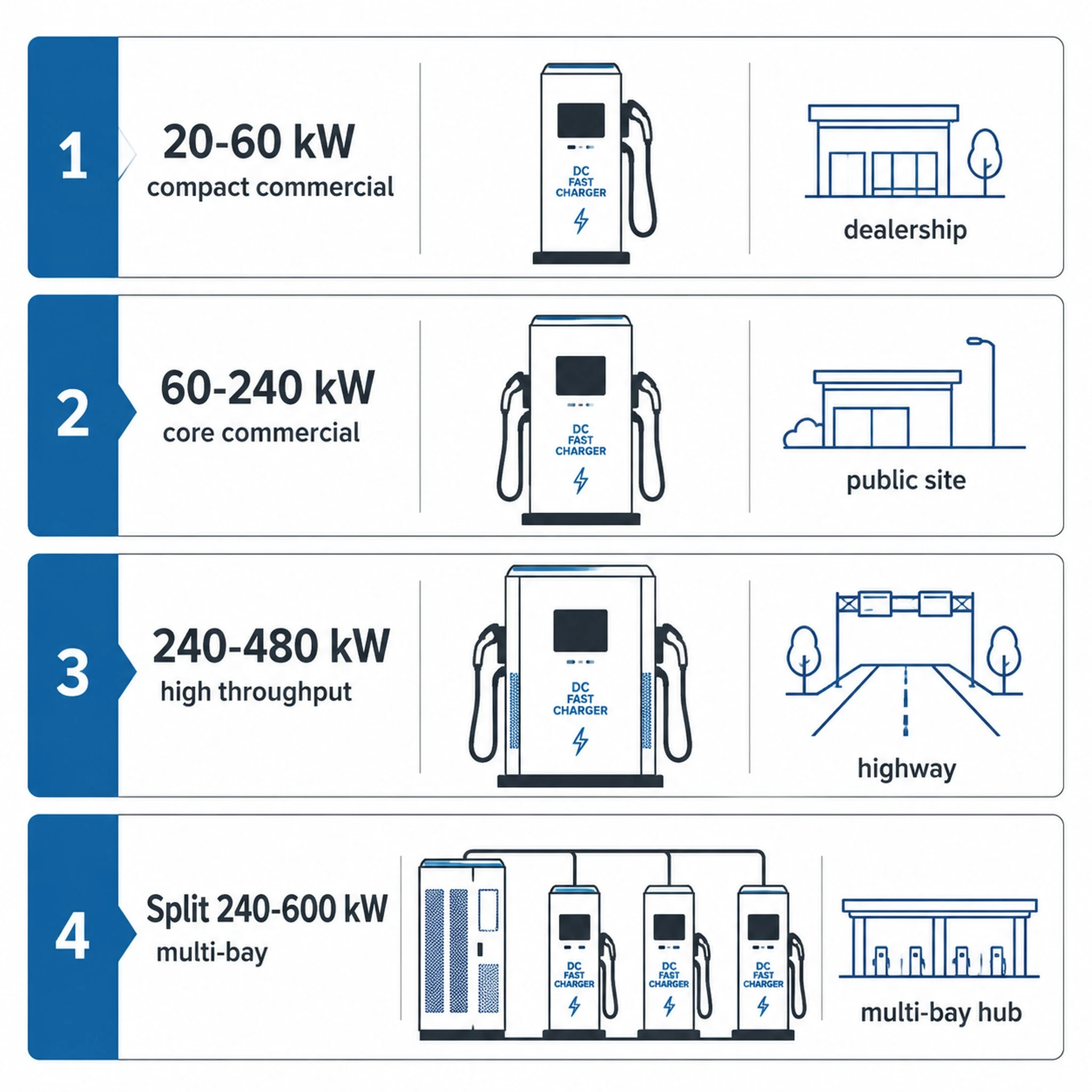
| Power band | Typical commercial role | Main selection questions | ETEK product direction |
|---|---|---|---|
| 20–60 kW | Dealerships, workplaces, service centers, destination sites, lower-utilization fleets | How long do vehicles stay? What electrical capacity is free? How many sessions per day? | Start with compact options such as EKDC1 on the ETEK DC fast charging category, then confirm the live product page |
| 60–240 kW | Public charging, retail sites, regional routes, fleet depots | What turnover is required? Which connectors? How many vehicles may charge at once? | Compare EKDC2 and related mid-band models against the datasheet |
| 240–480 kW | Highway charging, high-throughput public sites, larger depots | Can transformer, switchgear, and distribution carry the load? How is power allocated? | Review higher-power options such as EKDC3 with current documentation |
| Split 240–600 kW | Multi-bay hubs, bus or commercial vehicle sites, high-utilization operations | Is a central power cabinet needed? How many dispensers and bays? Is phased growth planned? | Check split architectures such as EKDC6 and the matching product pages |
20–60 kW: Longer Dwell, Smaller Commercial Sites
Use 20–60 kW where cars stay long enough to take useful energy without highway-style turnover—dealerships, workshops, workplaces, municipal fleets, hotels, destination parking.
This band is often easier to fit on an existing service than ultra-high power, but you still need a load study: sessions per day, energy per vehicle, operating hours, and other large loads on the same supply.
For many distributor and EPC quotes, this is the volume commercial band. If vehicles sit for hours and utility headroom is tight, a 60 kW unit can beat a larger cabinet that never runs near nameplate.
60–240 kW: Core Commercial DC Fast Charging
Most commercial DC projects land here: enough turnover for public and fleet use without designing every site as a mega-hub.
Retail, hospitality, and regional travel sites use it for passenger EVs. Fleets use it between shifts. The right number still depends on vehicle count, charge windows, pack size, and each vehicle’s DC limit.
Connectors and outputs matter more in this band. Two cables help access only if you know whether the system:
- Gives full rated power to one vehicle only
- Splits output when two connectors are active
- Allows configurable allocation from the management platform
- Ships a fixed or configurable connector mix for your market
Two guns ≠ two full-power sessions. Read the datasheet and operating logic before you lock the BOM.
On the ETEK side, open the DC Fast EV Charging Station category, then match EKDC1–EKDC6 to output, connectors, communications, and install type. Live product pages and datasheets win over series names.
240–480 kW: Throughput Is a Site Problem
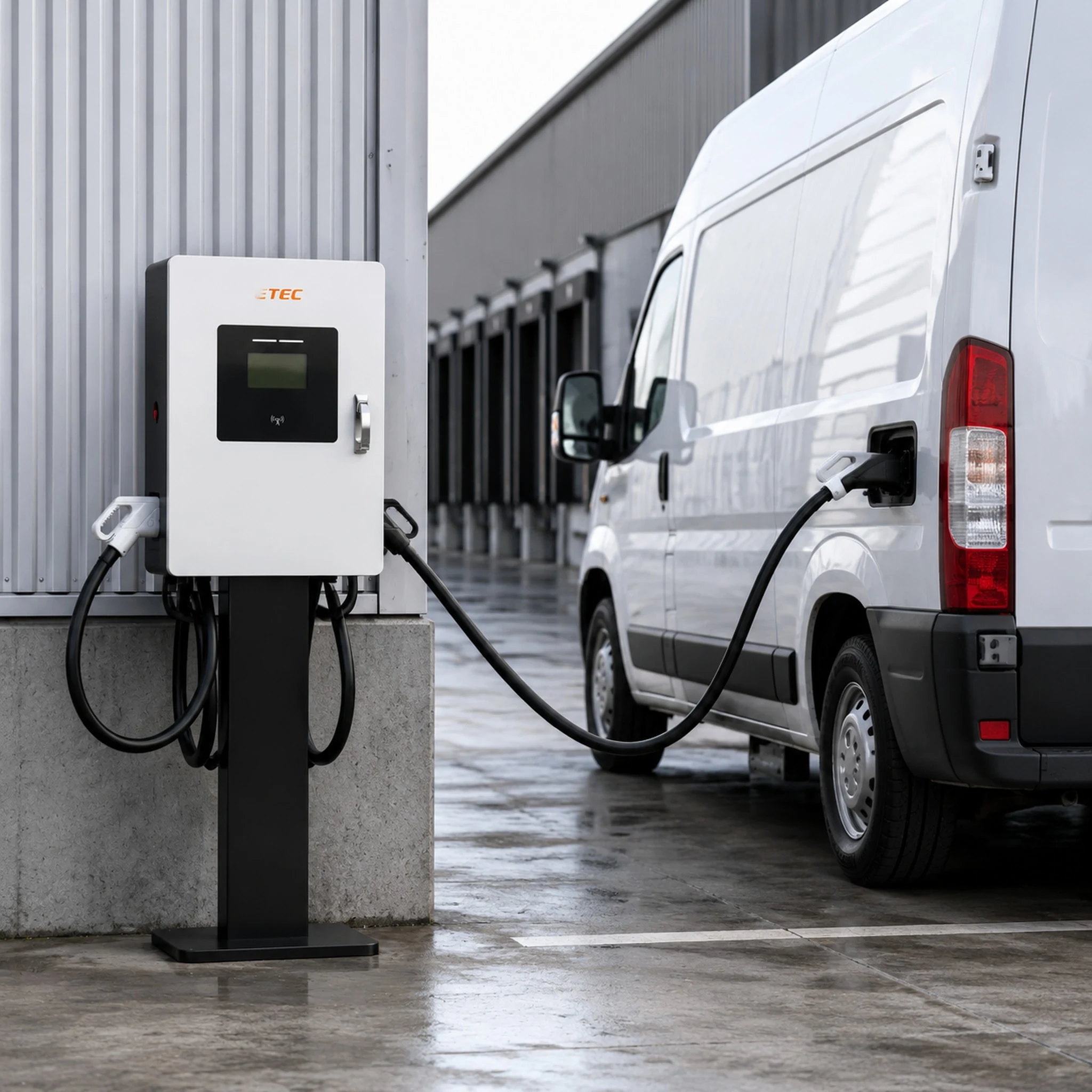
Consider 240–480 kW where speed and bay turnover are the business—highway corridors, large public hubs, depots serving high-acceptance DC vehicles.
The cabinet is only one piece. Confirm transformer capacity, switchgear, protection, cable routes, metering, utility rules, and connection headroom before you pick a model.
Utilization must be honest. A high-power unit on a quiet lot wastes capital. An undersized hub queues drivers and caps revenue. Forecast by hour, not only by day; peaks define the experience.
Split 240–600 kW: Central Power, Multiple Dispensers
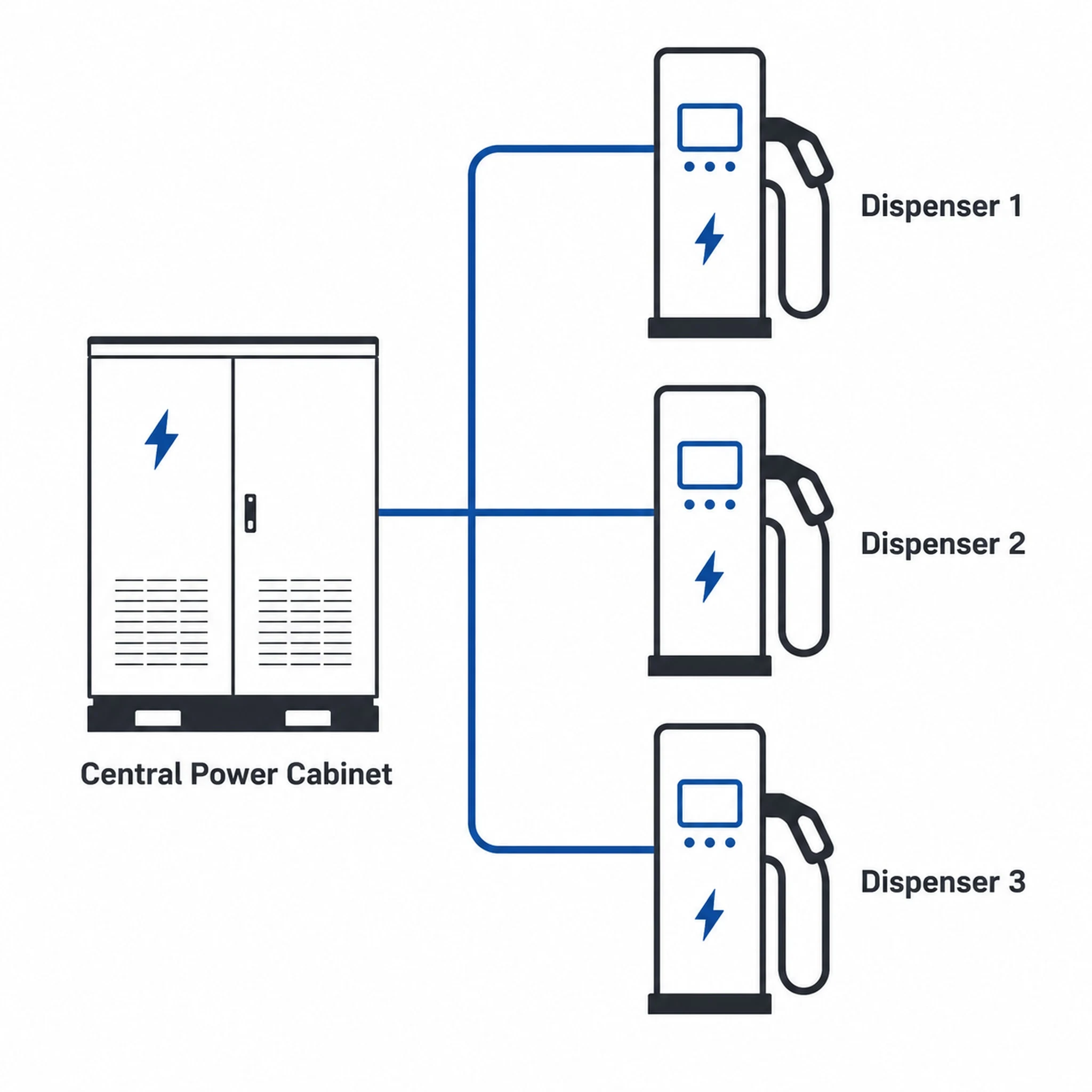
Split systems put the power cabinet away from the dispensers. They fit multi-bay hubs, commercial vehicle sites, and projects that need room to grow.
Layout is the point: power gear in a service zone, dispensers at the bays, cleaner public-facing circulation—subject to local install rules and cable limits.
Do not buy “600 kW” as a slogan. Decide whether you need centralized distribution, several active positions, and a growth path. Then fix dispenser count, cable runs, allocation behavior, and layout with engineering and the product docs.
Select Connectors for the Vehicles and Markets You Serve
Wrong connectors waste a correct kW rating. Match market, fleet, and business model first.
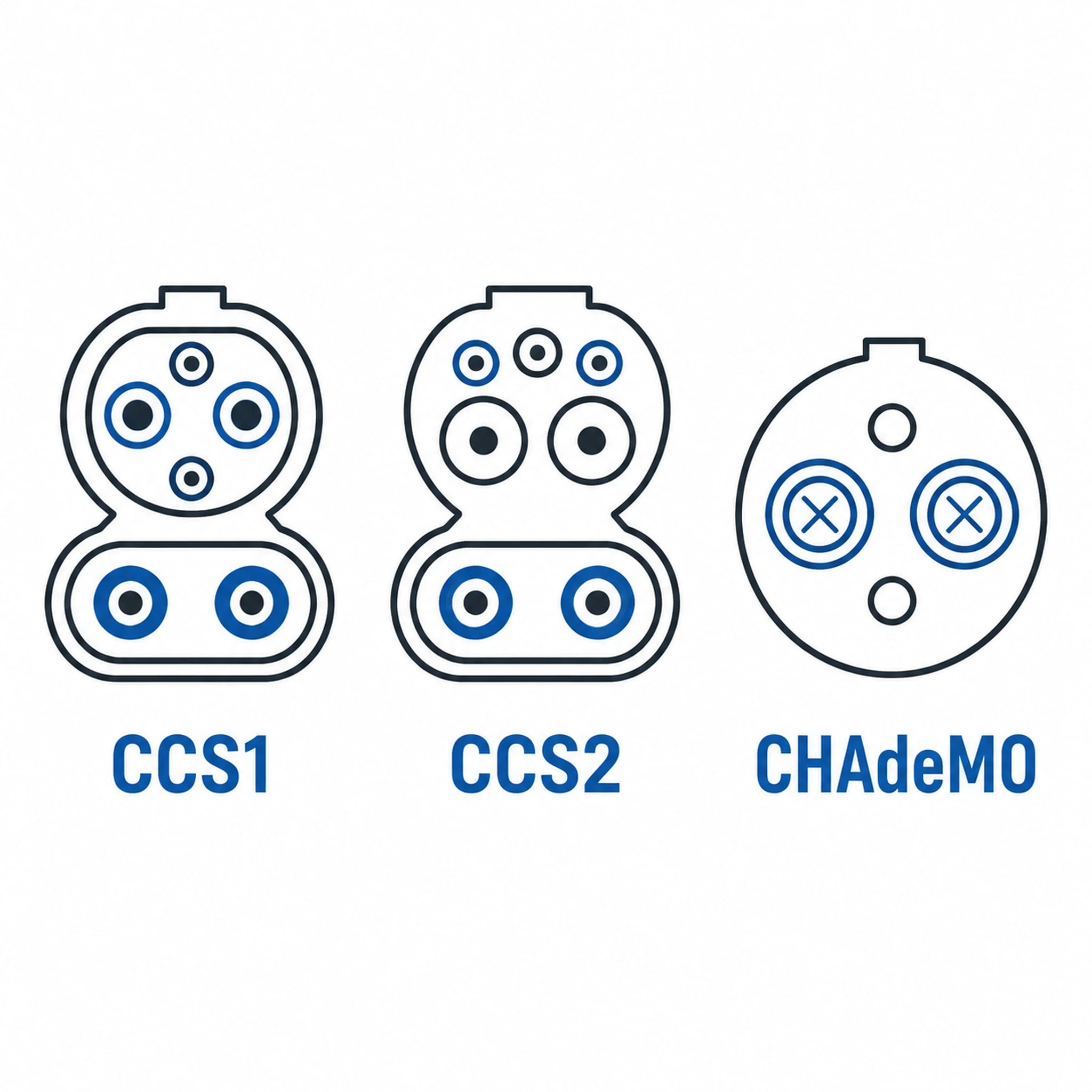
CCS is often central, but the variant is regional:
- CCS1 — common in North American infrastructure
- CCS2 — common in Europe and many export projects
- CHAdeMO — still relevant where that fleet remains
- Other plugs — only if the planned EV mix requires them
Do not copy a generic public-market mix onto a closed depot. Distributors should lock country, vehicle types, standards, and cable needs before quoting.
Final connector combinations for any ETEK unit come from that model’s product page and datasheet. Do not assume one EKDC configuration applies to the whole series.
Single-Gun, Dual-Gun, or Multi-Output
Gun count affects access, traffic flow, utilization, and how power is shared. Treat it as part of the operating model, not a checkbox feature.
One gun fits a dedicated bay—service lane, low-volume fleet stall, or a site that uses several independent cabinets. For the trade-offs between single- and dual-gun layouts, see our single- vs dual-gun DC fast charger guide.
Dual-gun and multi-output gear fits public and fleet sites that need more than one vehicle on the same cabinet. Before you specify it, answer:
- Can two vehicles charge at the same time?
- How is power split when both connectors are live?
- Is the advertised maximum for one vehicle only?
- Can the operator change allocation rules?
- Do the connector types match the market?
- Does the parking layout give cable reach and safe approach?
A depot may want balanced power across two vehicles. A highway stop may want maximum power on one short session. Match sharing logic to that use case.
Keep OCPP Specific
OCPP links the station to a charge point management system. Buyers care about monitoring, access control, billing, load management, remote diagnostics, and reporting—with the platform they already chose or plan to buy.
“OCPP supported” is not a purchase answer. Lock version, backend compatibility, connectivity, security expectations, remote-control needs, and who commissions what.
Practical checks:
- Name the CMS before you freeze charger options.
- Align OCPP version with both platform vendor and charger supplier.
- Define the link: Ethernet, cellular, or another approved path.
- Assign commissioning, backend setup, and support ownership.
- Pilot the charger-to-platform path before a large rollout.
This section is not a full OCPP design guide. Complex payment, roaming, or load-management stacks need their own review.
Check the Site Before You Freeze the Charger
Projects fail on site constraints even when the hardware is fine. Review electrical capacity, utility process, parking flow, civil works, communications, and maintenance access early.
Start with the supply: available service capacity and other large loads. Nameplate kW is not the same as what the site can feed at peak.
Then place the hardware: parking geometry, cable reach, approach direction, accessibility, impact protection, and service access. On split systems, cabinet-to-dispenser distance and routing dominate the drawing set.
Commercial stations also need a reliable path for backend, remote support, payment, and reporting. Weak cellular, unclear network ownership, or missing data plant delays go-live.
Site survey, electrical design, utility coordination, and local compliance belong to qualified professionals before you finalize procurement. This article does not give wiring or installation steps. For a practical pre- and post-install walkthrough, see the DC fast charger installation and commissioning checklist.
Map the Project to ETEK DC Fast Options
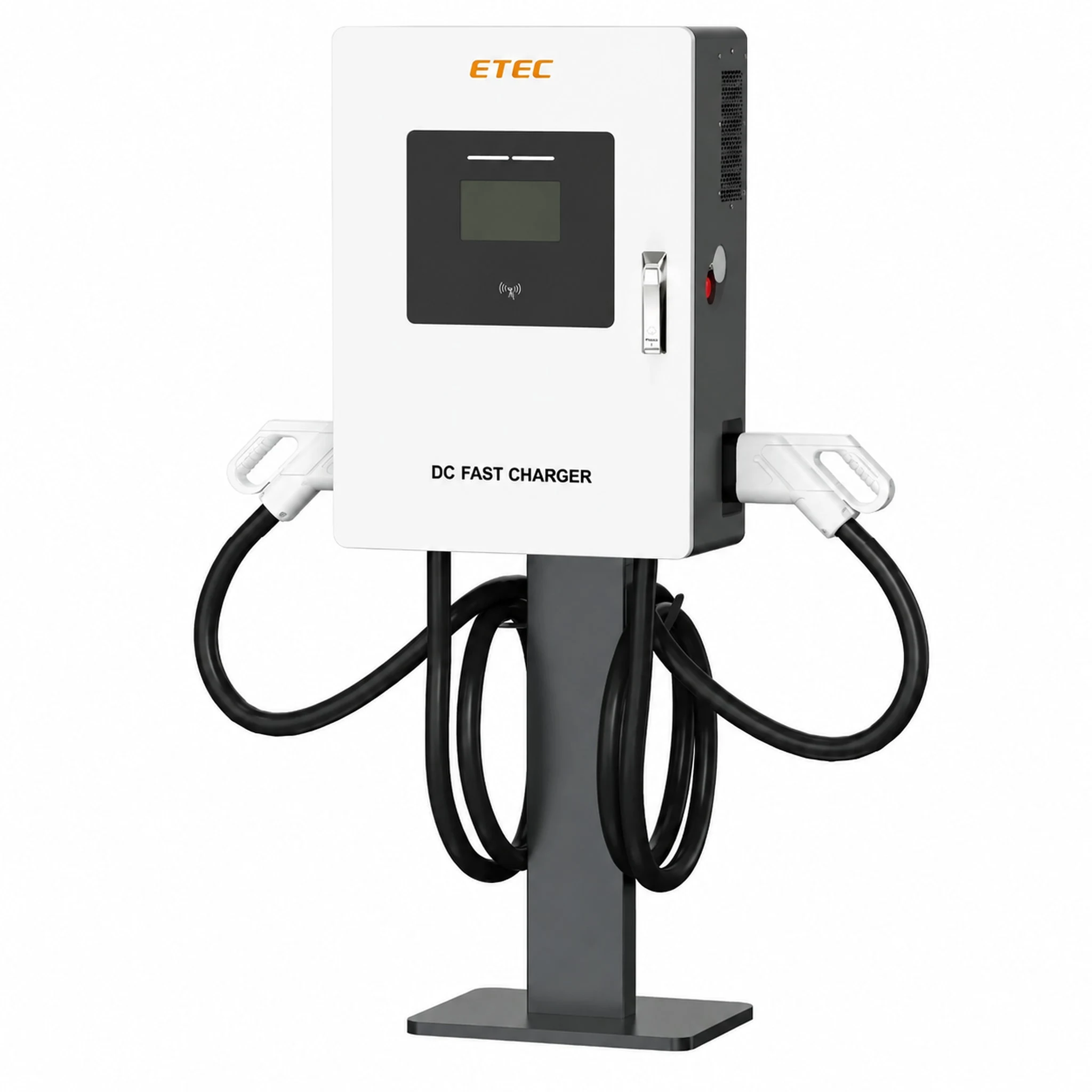
Treat the ETEK DC range as a power-band and application map, not a single SKU bet. Start at the ETEK DC Fast EV Charging Station category, then walk EKDC1–EKDC6 against the operating role you defined above.
Review order:
- Power range from dwell time and daily energy demand
- Market connector set
- Output count and simultaneous-charge behavior
- OCPP and communications
- Integrated cabinet vs split architecture
- Model-level check on current product pages and datasheets
Longer dwell and smaller commercial loads: start with compact DC options such as EKDC1 and test them against the charge schedule. Higher turnover: compare EKDC2 and EKDC3. Multi-bay or high-power split: review models such as EKDC6.
Availability, connector combos, exact ratings, and options are only final on the live product page or datasheet. Do not buy from a series name or a wide kW band alone.
Cost Is a Project Total, Not a Cabinet Price
A Level 3 station budget includes grid work, transformers, switchgear, trenching, cables, protection, civil construction, communications, permits, commissioning, backend services, and maintenance—not only the charger line item.
For a full cost framework, use the DC fast charger cost guide. In early selection, lock power need, utilization, site capacity, and architecture first; those choices move the budget more than a small difference in cabinet list price.
Final Selection Checklist
Before you issue a PO for a Level 3 EV charger, confirm:
- Power band from real dwell time and demand
- Vehicle types and connectors for the target market
- Charging positions and expected simultaneous sessions
- Power-sharing rules for multi-vehicle use
- Electrical capacity and utility limits
- OCPP version, CMS, and communications path
- Integrated vs split layout
- Civil, safety, accessibility, protection, and maintenance needs
- Current product page and datasheet for the chosen EKDC model
The common failure mode is buying from a kW figure alone. Define the operating need, stress-test it against the site, then map to the matching ETEK DC product.
Frequently Asked Questions
What is a Level 3 EV charger?
A Level 3 EV charger is generally a commercial DC station that supplies DC straight to the battery. It is often called a DC fast charger because sessions can be much shorter than AC charging, limited by the vehicle and battery conditions.
Is Level 3 charging the same as DC fast charging?
For commercial buyers, yes in practice: same equipment class. “Level 3” is market language in many English searches; “DC fast charging” is the usual technical and international catalog term.
Can a Level 3 EV charger be installed at home?
Home use is not the normal case. DC fast charging needs more electrical capacity, space, engineering, and project controls than typical residential AC charging. This guide is for commercial sites, fleets, EPCs, distributors, and operators.
How much power does a commercial DC fast charger need?
It depends on dwell time, sessions per day, vehicle DC limits, site capacity, and required throughput. Longer-stay sites often sit in 20–60 kW; rapid-turnover sites may need 240 kW and above.
Do dual-gun DC chargers charge two EVs at full power?
Not always. Some give full output to one vehicle; others split power or use another rule. Check that model’s datasheet and operating logic before you buy.
Why does OCPP matter for commercial charging stations?
OCPP is how many stations talk to a management system for monitoring, access, billing, diagnostics, and control. Confirm version and backend fit for the project—not only a checkbox on a brochure.
Conclusion
Select a commercial Level 3 EV charger as a site system. Set the power band from dwell time and demand, match connectors and guns to the fleet, fix OCPP and communications, and prove the electrical and civil design can carry the install. Then compare the relevant ETEK DC fast products on current pages and datasheets—starting from the DC fast category and models such as EKDC2, EKDC3, and EKDC6 where the power band fits.